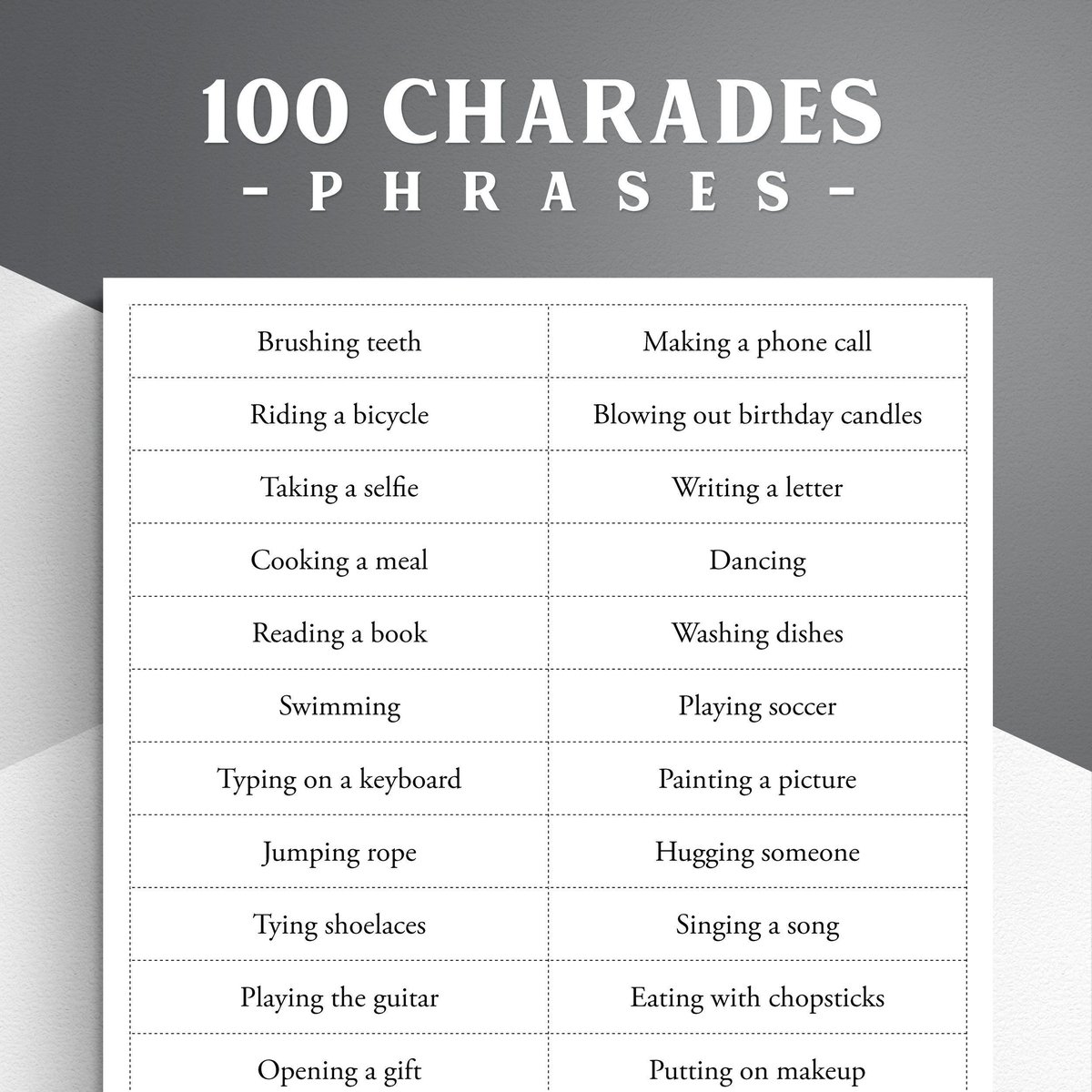
Forget screen time worries for a moment. If you're looking for a delightful, brain-boosting activity that brings families together, you've found it: charades. And unlocking its full potential for younger players hinges entirely on having the right Age-Appropriate Charades Word Ideas for Kids. This isn't just about picking random words; it's about tailoring the experience to foster confidence, creativity, and connection at every developmental stage.
At a Glance: Your Quick Charades Toolkit
- Adaptability is Key: Charades is highly adjustable for any age, from toddlers to teens.
- Match Words to Minds: Choose simple, familiar words for younger kids; introduce complexity and abstract concepts as they grow.
- Help Non-Readers: Whisper words or use pictures on cards to ensure everyone can play.
- Master the Gestures: Universal charades hand signals can significantly smooth gameplay, especially for older children.
- Beyond Just Fun: This classic game boosts creative thinking, communication skills, mood, and family bonds.
- Ready-Made Inspiration: Explore our curated lists of word ideas and recommended games to kickstart your next charades session.
Why Charades? More Than Just Mime Time
In a world full of digital distractions, charades offers a refreshing return to interactive, imaginative play. It's a simple, timeless game where one person acts out a word or phrase silently for others to guess, turning everyday concepts into hilarious, non-verbal puzzles. Beyond the giggles and friendly competition, the benefits for children are profound.
The American Academy of Pediatrics even supports charades as a flexible and engaging game, particularly beneficial for kids managing chronic illnesses, highlighting its broad applicability and positive impact. It's a fantastic vehicle for promoting:
- Creative Thinking: Players learn to think on their feet, transforming abstract ideas into physical movements.
- Non-Verbal Communication: Kids develop a deeper understanding of body language, facial expressions, and gesture, essential skills for life.
- Stress Reduction & Mood Boosting: Laughter is the best medicine, and charades delivers it in spades, helping to alleviate tension and lift spirits.
- Connection & Teamwork: Whether played collaboratively or competitively, charades fosters a sense of shared experience and encourages players to work together toward a common goal.
Ready to dive in? Let's explore how to make charades a roaring success for your crew.
The Core Mechanics: How Charades Works for Kids
Charades is beautifully simple, but its true genius lies in its flexibility. You can tweak almost every aspect to suit your players' ages, interests, and energy levels.
Setting Up for Success:
- Word Prep: Write words or phrases on individual slips of paper, fold them, and place them in a hat, bowl, or bag.
- The Actor's Turn: One player picks a word, reads it silently, and then acts it out.
- The Guessers' Task: Other players call out guesses based on the actor's performance.
Customizing for Every Child:
- Adjusting Word Complexity: This is paramount.
- Younger Children: Stick to simple, one-syllable words or familiar actions they can easily mimic.
- Older Children: Introduce harder words, simple two- or three-word phrases, or more nuanced concepts.
- Oldest Children & Teens: Challenge them with longer phrases, abstract ideas, book/movie titles, or more obscure words.
- Considering Reading Ability:
- For Non-Readers: Whisper the word directly to the child, or draw a simple picture on the card alongside the word itself. This ensures everyone feels included, regardless of their literacy level.
- For Developing Readers: Use large print and familiar vocabulary.
- Tuning into Experiences: Always choose words and phrases that your guessers are likely to be familiar with. There's nothing more frustrating than trying to guess a movie title you've never heard of!
The Golden Rules: - Silence is Golden: Actors cannot speak or make any noises. Pure mime!
- No Pointing at Objects: Actors can't point directly at real-life objects to give clues.
- Time Limits: Set a fair time limit, typically one minute per actor. If the word isn't guessed, the actor reveals it, and play continues.
- Scoring: You can play purely collaboratively (the goal is just to guess as many as possible) or competitively (points for correct guesses, with the team or individual with the most points winning). Collaborative play is often best for younger kids to keep the focus on fun.
Universal Gestures: Your Secret Weapon for Smoother Play
For older children (and adults!), introducing these universal charades gestures can significantly enhance gameplay, making it easier to convey complex ideas: - "It's a book": Bring hands together, then open them like a book.
- "It's a movie": Pretend to crank an old-style movie camera.
- "How many words?": Hold up fingers for the number of words in the phrase.
- "Which word?": After indicating the number of words, hold up fingers again to specify which word in the phrase you're currently acting out (e.g., hold up two fingers for the second word).
- "Small word": Hold your forefinger and thumb close together.
- "Sounds like": Tug on your earlobe.
- "Long word": Stretch your hands apart, as if measuring something long.
Crafting the Perfect List: Age-Appropriate Charades Word Ideas for Every Stage
The key to successful charades with kids is selecting words that are challenging enough to be fun, but not so hard they lead to frustration. Here's a breakdown by age group, along with general categories that work well.
Preschoolers (Ages 3-5): Simple Actions and Familiar Friends
For the youngest players, think simple, concrete, and highly familiar. Focus on single-word concepts or very short, basic actions. Visuals or whispering the word can be a big help here.
Categories & Examples:
- Actions (Easy): These are perfect as preschoolers often communicate through movement.
- Examples: Running, sleeping, eating, jumping, waving, crying, laughing, brushing teeth, singing.
- Animals (Easy): Choose animals with very distinct movements or sounds (remember, no sounds!).
- Examples: Cat, dog, fish, bird, snake, bear, pig, elephant, frog.
- Objects (Very Easy): Focus on things they interact with daily.
- Examples: Ball, book, cup, car, phone, apple.
- Emotions (Simple): Basic feelings are great for developing emotional literacy.
- Examples: Happy, sad, angry, surprised.
Early Elementary (Ages 6-8): Expanding Horizons
Children in this age group are developing stronger verbal skills and a broader understanding of the world. They can handle slightly more complex words and simple two-word phrases.
Categories & Examples:
- Actions (Challenging): More nuanced activities they might participate in or observe.
- Examples: Swimming, reading, cooking, gardening, dancing, climbing, riding a bike, doing homework.
- Objects (Familiar): Everyday items, some of which might relate to activities.
- Examples: Backpack, toothbrush, guitar, clock, television, hat, umbrella, banana, pizza.
- Places (Familiar): Places they regularly visit or hear about.
- Examples: School, park, beach, zoo, library, home, store.
- Animals (More Distinct): Animals with unique movements that are fun to mimic.
- Examples: Monkey, penguin, crocodile, giraffe, lion, T-rex.
- Disney/Characters (Recognizable): Beloved characters or simple movie titles from popular kids' films.
- Examples: Mickey Mouse, Dumbo, Cinderella, Moana, Elsa.
- Food (Fun to Act Out): Foods with distinct shapes or eating actions.
- Examples: Ice cream cone, sandwich, popcorn, cupcake, spaghetti, watermelon.
Late Elementary & Pre-Teens (Ages 9-12): Ready for Complexity
This age group thrives on a good challenge. They can handle longer phrases, abstract concepts, and specific titles. Universal gestures become very helpful here.
Categories & Examples:
- Actions (Tricky): Actions that require more sophisticated mime.
- Examples: Juggling, hula-hooping, playing soccer, skiing, diving, conducting an orchestra, painting a picture.
- Objects (More Abstract): Objects that might be part of a bigger scene.
- Examples: Camera, telescope, computer, skateboard, microscope, binoculars.
- Places (Beyond the Local): Broader geographical or specific types of locations.
- Examples: Airport, restaurant, museum, mountain, jungle, ocean, space station.
- Animals (Unique Traits): Animals known for particular behaviors or appearances.
- Examples: Chameleon, sloth, platypus, kangaroo, owl.
- Books/Movies (Popular Titles): Titles they are likely to know, even if multi-word.
- Examples: Harry Potter, Charlotte's Web, Finding Nemo, The Lion King, Diary of a Wimpy Kid.
- Sports (Specific Actions): Sports that involve clear, distinct movements.
- Examples: Basketball, baseball, golf, tennis, volleyball, boxing.
- Professions (Challenging): Jobs with characteristic tools or movements.
- Examples: Doctor, astronaut, firefighter, musician, chef, teacher, scientist.
Teens & Family Play (Ages 13+): The Obscure and the Abstract
For bright sparks who can think creatively and aren't afraid of a real challenge, these ideas are designed to test their miming and guessing prowess. This is where those universal gestures become indispensable.
Categories & Examples:
- Actions (Advanced/Obscure): Complex, abstract, or highly descriptive actions.
- Examples: Scuba diving, parachuting, levitating, deciphering codes, quantum leaping, performing surgery.
- Objects (Conceptual): Items that might require more imaginative acting.
- Examples: Invisible cloak, time machine, magic wand, black hole, unicorn horn.
- Places (Global/Imaginary): Famous landmarks, countries, or fictional locations.
- Examples: Eiffel Tower, Great Wall of China, Narnia, Atlantis, Outer Space.
- Animals (Mythical/Rare): Creatures that are hard to act or guess.
- Examples: Yeti, Kraken, Unicorn, Dragon, Griffin.
- Books/Movies (Complex Titles): Longer, more obscure, or less common titles.
- Examples: Lord of the Rings, The Hitchhiker's Guide to the Galaxy, Wuthering Heights, Inception.
- Sports (Niche/Difficult): Sports that are harder to act out convincingly.
- Examples: Fencing, synchronized swimming, skateboarding, curling, quidditch (fictional).
- Professions (Specialized): Less common or highly specific jobs.
- Examples: Architect, archaeologist, cryptographer, sommelier, stand-up comedian, botanist.
- Food (Gourmet/Abstract): Foods that require more than just eating actions.
- Examples: Sushi, fondue, molecular gastronomy, ambrosia (mythical food).
Seasonal & Themed Charades: Adding a Festive Twist
Tailoring your charades to holidays or special events is a fantastic way to celebrate and keep the game fresh.
- Christmas (Seasonal): Embrace the magic of the season.
- Examples: Jingle bells, wreath, gift, Santa, stocking, Christmas tree, reindeer, snow, manger, angel, baby Jesus.
- Halloween (Seasonal): Spooky and fun, but remember to avoid words that would be too easy if someone is already in costume (e.g., "witch" if someone is dressed as a witch).
- Examples: Trick or treat, costume, zombie, monster, ghost, vampire, pumpkin, jack-o-lantern, spider, haunted house, candy corn, skeleton, bat.
Tips for Brainstorming & Card Prep
Creating your own charades cards is part of the fun! Here are some pointers:
- Keep it Clear: Use large, clear writing on each slip of paper.
- One Idea Per Card: Avoid confusion by sticking to a single word or phrase per card.
- Draw if Needed: For younger, non-reading children, a quick sketch next to the word makes a world of difference.
- Familiarity First: Always prioritize words that your group will likely know. The goal is fun, not frustration.
- Mix it Up: Include a range of difficulties within your chosen age bracket to keep everyone engaged. Some easy wins build confidence, while harder words offer a satisfying challenge.
- Outsource the Ideas: Don't want to brainstorm? You can find endless word suggestions and even generate random ones. In fact, many families enjoy using a good children's charades generator to get fresh ideas quickly and ensure age-appropriateness.
Beyond the Cards: Top Charades Games for Kids
If you prefer a ready-made experience, there's a fantastic array of charades-style games designed specifically for children, often incorporating visuals, different difficulty levels, and fun twists.
No-Reading-Required (Ages 3+): Perfect for Little Ones
These games rely on pictures or direct verbal clues, making them accessible to preschoolers and early readers.
- Kids on Stage (University Games): A travel-friendly tin with 100 picture topic cards and a color-coded spinner, making it easy to select categories.
- Junior Charades (Pressman): A boxed game featuring a game board and 60 topic cards, often with visual cues.
- Picture Charades (Melissa & Doug): Nearly 200 colorful, illustrated picture cards provide ample ideas for non-readers.
- Frozen II Charades Game: A themed board game that includes collectible figurines and 52 game cards, offering one picture and three topics each for varied difficulty.
Literate Kids (Various Ages): Ready for Words
For children who can read, these games offer structured play with pre-selected word lists.
- Hasbro Guesstures: This speedy charades game features 320 topic cards in three difficulty categories. A unique mechanism makes cards "disappear" if not guessed quickly, adding an exciting time pressure.
- Act it Out! Charades (Imagination Games): A travel-friendly, pocket-sized card game with 65 cards, boasting over 300 topics, great for on-the-go fun.
- Charades for Kids (Out of the Box): Features 50 game cards with more than 300 charade topics, designed specifically for children's interests.
- Act It Out (Peaceable Kingdom): A cooperative charades-style game where players perform funny acts, perfect for solo play, partnerships, or groups without competitive pressure.
Advanced Charades (Older Kids/Teens): Stepping Up the Challenge
For those who crave more complex topics and faster play.
- Charades! The Party Game: Offers 100 cards with over 500 interesting and varied topics, suitable for a more experienced group.
- Rapid-Fire Charades: Teams race against the clock to guess multiple charade topics, with 280 cards each containing five topics (1400 topics total), ensuring hours of play.
Family-Friendly (Mixed Ages): Fun for Everyone
These games are designed to bridge the age gap, making charades a fantastic activity for the whole family.
- Charades Compendium: A versatile set that includes six games in one box, adaptable for ages 4 to 14+, ensuring something for every family member.
- Heads Up! (Spin Master): While a digital app is popular, the physical card game offers 150 topic cards (each with a single picture and two word suggestions for varying difficulty), allowing no-reading-required play for younger kids while still challenging older ones.
- Charades Kids vs Parents: This game features four distinct card decks: Kids (ages 8+), Family, Movie, and 80s and 90s (for teens/adults), creating balanced teams and varied challenges for a fun family showdown.
Maximizing the Fun: Pro Tips for Seamless Charades
A few extra pointers can elevate your charades experience from good to absolutely fantastic:
- Emphasize Fun Over Winning: Especially with younger kids, make the goal about laughing and being creative, not just about who guesses fastest or scores the most points.
- Be an Encouraging Audience: Applaud efforts, even if the acting is a bit off or the guesses are way out there. Positive reinforcement keeps everyone engaged and willing to try again.
- Lead by Example: If a child is hesitant, jump in and act out a super simple word with enthusiasm. Show them how much fun it can be.
- Rotate Roles: Ensure every child gets a turn to act and guess. Some kids prefer one role over the other, but encourage them to try both.
- Keep it Moving: If a word is proving too difficult, gently suggest the actor reveal it and pick a new one. Don't let a single word stall the game.
Ready to Act It Out? Your Next Steps
You're now armed with a wealth of Age-Appropriate Charades Word Ideas for Kids, a clear understanding of how to tailor the game, and a list of excellent ready-to-play options. Charades isn't just another game; it's an opportunity to create lasting memories, spark imagination, and build essential communication skills in a joyful, collaborative environment.
So, gather your family, grab some paper and a pen (or your chosen game), and prepare for an evening of laughter, creativity, and connection. The stage is set, the words are waiting, and the fun is just a mime away!